
By Rekha Radhakrishnan
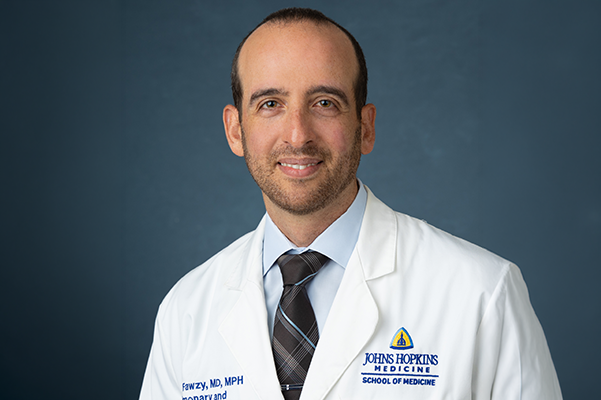
There is a firm but not always patently visible thread connecting medicine and engineering. Both disciplines share a problem-solving mindset, probing scientific principles to design solutions that are feasible and scalable. Dr. Ashraf Fawzy’s research trajectory as a pulmonary and critical care physician and associate professor of medicine at the Johns Hopkins University School of Medicine embodies the synthesis of an engineering and medicine mindset, pursuing how information is gathered by medical devices and working to solve irregularities at a large scale.
Dr. Fawzy’s path to groundbreaking research uncovering differences in pulse oximeter readings based on skin pigmentation wasn’t clearly defined. After completing a Master of Public Health at Columbia University, he knew that research would be an important part of his career. “I wanted to apply my love of fixing things to a broader, global context.” After working on HIV care delivery in low- and middle-income countries, he decided to pursue an internal medicine residency followed by a pulmonary and critical care fellowship, where he could focus on caring for critically ill patients. Dr. Fawzy’s passion for research clicked into place under the mentorship of Dr. Nadia Hansel, director of the Johns Hopkins Department of Medicine and a pulmonary and critical care physician, where he examined the inflammatory role of platelets in people with Chronic Obstructive Pulmonary Disease (COPD) and whether drugs like aspirin can help.
However, it was during the COVID-19 pandemic that his path forked after reading a piece in the New England Journal of Medicine about racial bias in pulse oximeter readings, a critical diagnostic tool for the thousands of people flooding emergency rooms with a spate of worrying symptoms. The pulse oximeter measures oxygen saturation in the blood, often clipped onto a finger, by contrasting how much two wavelengths of light go through the finger without getting absorbed by tissue and blood. The article indicated that the oximeter reading wasn’t as accurate in Black patients, which both yielded surprise and synced with Dr. Fawzy’s clinical experience in the Johns Hopkins intensive care unit (ICU) during the pandemic. This sparked his desire to find out more about the difference in readings and how it impacted care, particularly during the COVID-19 pandemic, when the oximeter reading became critical to understanding lung function and making clinical decisions. Looking at data from over 7,000 patients from the Johns Hopkins Precision Medicine Center of Excellence for COVID-19, Dr. Fawzy learned that Black and Hispanic patients were both 20-30 percent less likely than white patients to have pulse oximeter readings that recognized their eligibility for more aggressive COVID-19 treatment in a timely fashion.
In addition to having an immediate impact, with the Food & Drug Administration holding a Medical Devices Advisory Committee meeting to review regulatory requirements for the pulse oximeter, Dr. Fawzy has expanded his research with a recent National Institutes of Health R01 award to better understand the flaws of pulse oximeters in care settings where factors like dangerously low blood pressure and life support medication to bring it up interact with skin pigmentation and impact oximeter readings. The award also taps into Dr. Fawzy’s engineering origins, testing a device in the Johns Hopkins ICU developed by Dr. Ulkuhan Guler at Worcester Polytechnic Institute that measures the amount of oxygen diffusing through the skin to estimate how much is not attached to hemoglobin, which has meaningful clinical relevance since it is measuring oxygen that the body’s tissues can access. Dr. Fawzy believes awareness about the limitations of pulse oximeters among physicians is crucial for clinical decision making but ultimately, he believes “we need a new way of measuring oxygen that doesn’t introduce bias from the very beginning.”
Dr. Fawzy sees the interplay between clinical care and research as vital to shaping what ideas get examined. “I see patients in a lot of different settings including the ICU and outpatient clinics, and it has affected my perspective enormously, giving me insight into the different patient populations affected by these issues. In order to ask the right questions in research, you have to think about problems in a way that is concordant with real life.”
He also credits mentorship from Dr. Hansel and Dr. Jack Iwashyna, a Bloomberg Distinguished Professor and critical care physician at Johns Hopkins Medicine, who helped shepherd his R01 grant; and the Center for Innovative Medicine for allowing him to pursue research that challenges conventional thinking and isn’t always funded by larger institutions. “There is no way that I could have achieved a fraction of what I did without mentors who reminded me that a researcher’s career is rarely linear and encouraged me to pursue my interests.”
Is there a DOM researcher you'd like to know more about? Let us know at [email protected]. They could be our next DOM Research Profile.
