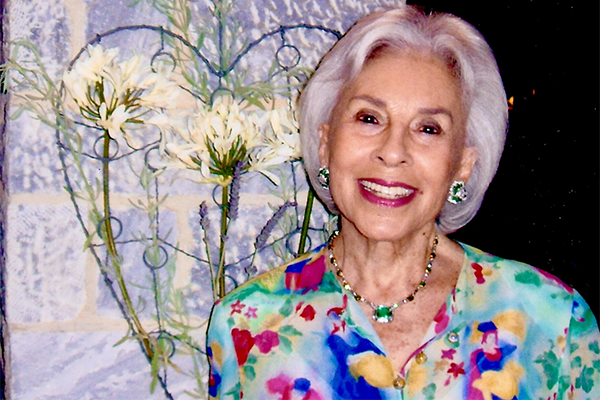
With sadness, we announce that Mrs. Aliki Perroti passed away last week at the age of 101. Aliki was one of Greece’s major philanthropists, and her visionary support of education and healthcare in both Greece and the United States leaves an enduring legacy.
Aliki’s father was a renowned civil engineer who lost everything during World War II because he refused to collaborate with the Nazis during their occupation of Greece. After the war, he rebuilt, developing an enormously successful company that constructed roads, ports, and airports across Greece and the Middle East. Later, he also established a thriving shipping company.
To honor the memory of her parents, Aliki established and solely funded a 285-bed hospital in Athens. She also founded and funded the Dimitris Perrotis College of Agricultural Studies at the American Farm School in Thessaloniki, Greece.
In addition to her work in Europe, Aliki was a major benefactor of Johns Hopkins and the Center for Innovative Medicine. In 2006, she endowed the Aliki Perroti Professorship at Johns Hopkins, naming Dr. David Hellmann as its inaugural recipient. In 2007, she funded "the Aliki Initiative" at Bayview, which aimed to teach every medical student and resident the vital importance of knowing the patient as a person. Aliki believed deeply in the adage attributed to William Osler: "The good doctor treats the disease, and the great doctor treats the person with the disease." She took immense pride in the Aliki Initiative and returned to Johns Hopkins several times to celebrate its success. In 2019, she made another major contribution to further support the endowed chair and Dr. Hellmann.
Aliki was remarkable not only for her wealth and generosity, but because she was a true trailblazer who shattered the limitations so often placed on women of her generation. Early in life, she defied restrictions on female education by passionately pursuing her studies, ultimately becoming fluent in German, French, and English alongside her native Greek. She similarly refused to abide by customs limiting women's leadership in public life. At a time when the Greek government actively discouraged philanthropy by taxing private donations, Aliki stood her ground and emerged as a towering figure of public benevolence.
